A Physician in Flight: Medicine and Catastrophe in Pompeii
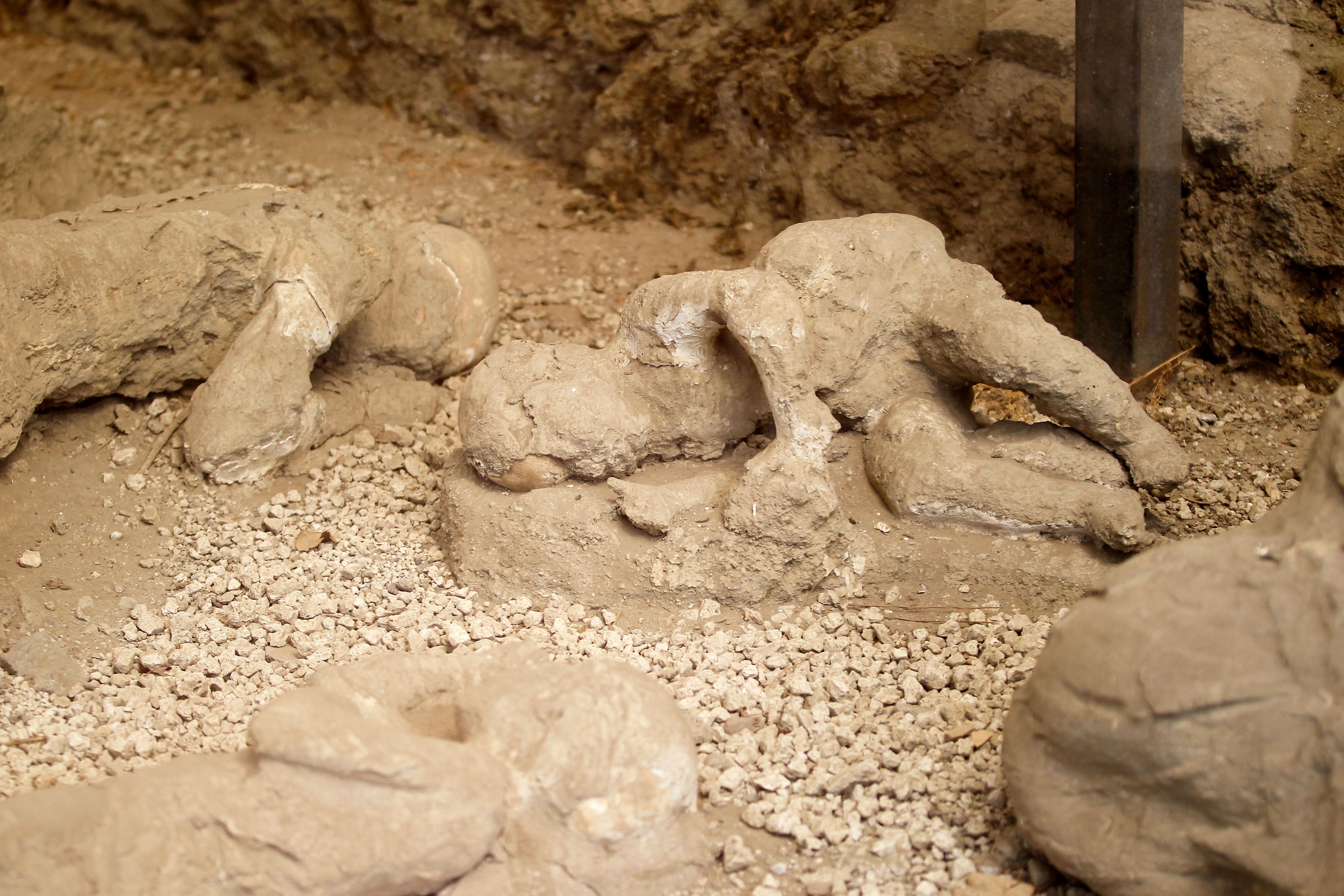
The Orto dei Fuggiaschi remains one of the most haunting areas of Pompeii. Excavated during the 1960s, the site contained the bodies of individuals who had attempted to flee the city as a pyroclastic surge swept across the landscape. Their forms survived because the volcanic ash hardened around the decomposing bodies, leaving cavities that were later filled with plaster by archaeologists. The resulting casts preserve not only the positions of the victims in their final moments, but occasionally traces of clothing, personal possessions, and even expressions of fear.
Archaeologists working at Pompeii have re-examined one of the victims recovered from the so-called “Garden of the Fugitives”, identifying what may be the remains of a Roman medicus. The interpretation does not rest on inscriptions or skeletal analysis, but on a sealed group of objects preserved within one of Pompeii’s famous plaster casts: a compact case containing surgical instruments, a slate preparation plate, and traces of organic material.
The newly reinterpreted cast was first excavated in 1961, though the fragile contents sealed within it remained difficult to study directly without risking damage. Recent CT scanning and X-ray imaging have now allowed researchers to reconstruct the arrangement of the objects non-invasively, revealing a small assemblage strongly associated with Roman medical practice. Among the items identified are metal instruments likely used in surgical or therapeutic procedures, together with a slate palette probably intended for grinding or mixing medicinal substances. Residue analysis may yet clarify what kinds of compounds were being prepared or carried.
Roman medicine combined practical treatment with inherited Greek medical theory, particularly the ideas associated with Hippocrates and Galen. Physicians relied on a wide range of remedies: herbal preparations, dietary regulation, cauterisation, and relatively sophisticated surgical techniques. Excavations across the Roman world have uncovered scalpels, forceps, probes, bone levers, and cupping vessels remarkably similar in form to instruments that continued in use well into the medieval period. In this sense, Roman and medieval medicine were not entirely separate traditions, but part of a long continuum of learned practice that survived the collapse of Roman political authority. Most medical treatment, however, remained personal and mobile. Physicians travelled between households and communities carrying compact kits of instruments and medicinal materials, much like the one now (possibly) identified at Pompeii.
The assemblage captures something of the practical reality of urban medicine: not a doctor represented abstractly in a text or funerary inscription, but an individual still carrying the tools of their profession while attempting to escape catastrophe.