The Urfa Man: A Body without a Voice
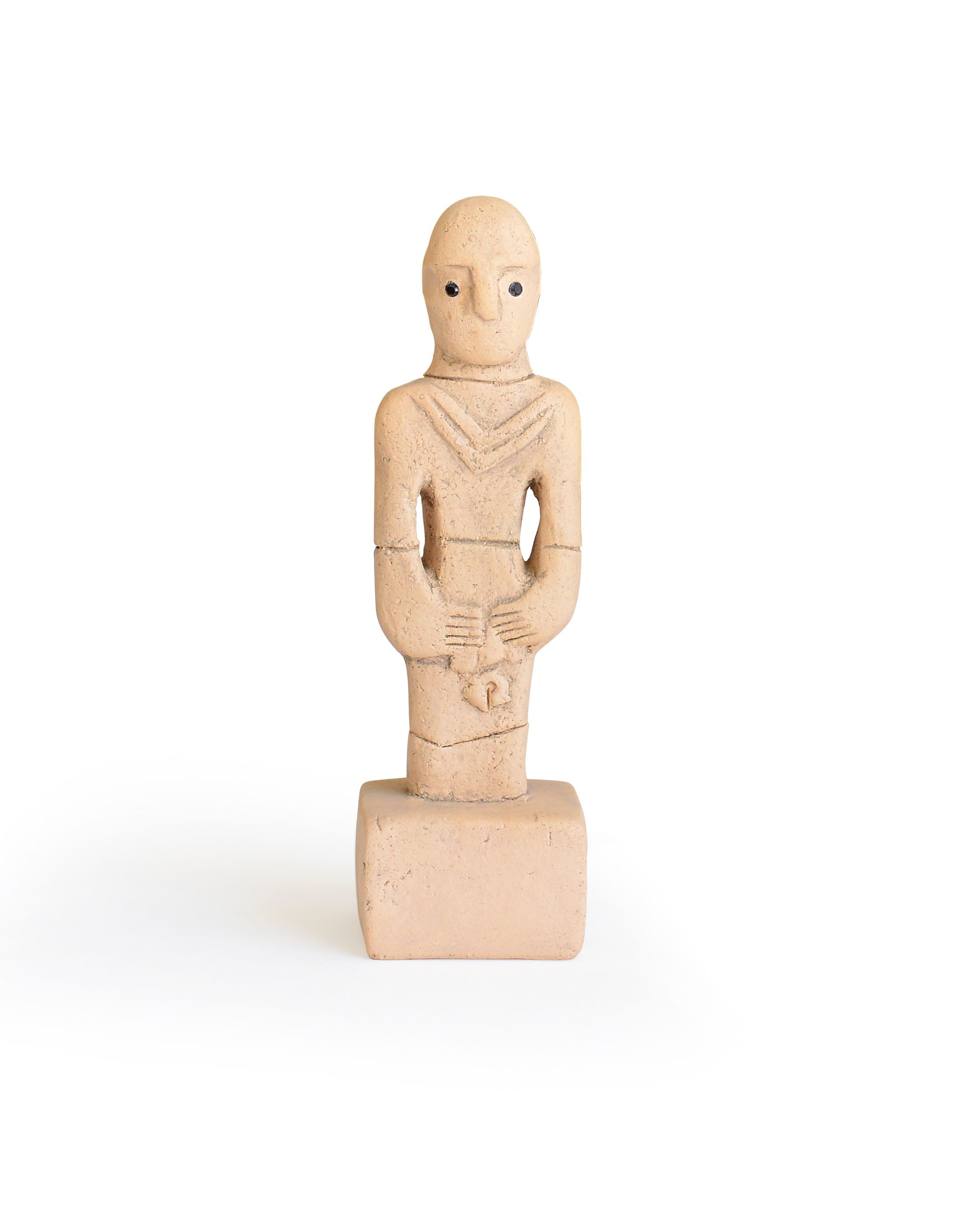
The limestone figure known as the Urfa Man, now held in the Şanlıurfa Archaeological Museum, is among the earliest known life-size human sculptures. Discovered in the wider Şanlıurfa region in southeastern Anatolia and dated to around 9500 BCE, it is associated with the early Neolithic monumental tradition of the Taş Tepeler landscape.
The figure presents a rigid, frontal male body: the torso is flattened and schematic; the legs taper into a simplified base; and the arms are drawn forward to frame a prominently carved phallus. The head is highly controlled: obsidian-inlaid eyes set deep into the skull, a sharply defined nose, and the deliberate absence of a mouth. The overall effect is one of extreme reduction, where anatomy is not described but selectively constructed.
Recent interpretations emphasise that this is not a damaged or incomplete object, but a deliberate choice of emphasis and omission. The missing mouth is particularly interesting. It may signal a condition beyond speech and breath, perhaps death. It could be that the statue embodies a concept of a non-living presence that still holds meaning, authority, or ritual significance.
The treatment of the genital area has become central to recent re-evaluations in interpretation. It is often suggested that any emphasis is a straightforward symbol of fertility, but findings in the wider region complicate this view. At sites such as Karahan Tepe, male figures frequently foreground the phallus, sometimes within structured or narrative compositions. The Urfa Man, however, holds a formalised and isolated gesture. This has led to interpretations that move beyond fertility in a biological sense and towards a condensed expression of masculine potency possibly linked to origin and lineage. The body is reduced to a small number of charged elements that do not suggest individuality. It isn’t identity that is conveyed, but function.
This reading is sharpened when placed alongside earlier prehistoric female figurines – “Venus” figures – in which fertility is expressed through emphasised and enlarged breasts, hips, and abdomen. Those forms are often interpreted as evocations of fecundity or earth-based abundance. The Urfa Man, by contrast, compresses meaning into a single focal point. Fertility, if it is present at all, is not expansive but concentrated.
It is likely that this statue, like similar figures found at Göbekli Tepe, was viewed in, and formed part of a ritual environment. Perhaps it operated as part of a wider system of encounter, activated through setting, movement, and collective attention rather than passive viewing. Seen from this light, the Urfa Man appears to articulate a broader preoccupation with origins – of persons, of groups, and of continuity itself.
Above: photo of the statue in its current setting