Tiberius as Pharaoh: A Roman Emperor in Karnak
At the Karnak Temple Complex in Luxor, archaeologists have recently uncovered a sandstone stele depicting the Roman emperor Tiberius in the guise of an Egyptian pharaoh. Found in the northern sector of the Amun-Ra precinct, the relief dates broadly to the reign of Tiberius (A.D. 14–37). Measuring approximately 60 × 40 cm, it shows a standing ruler making an offering before the so-called Theban triad: Amun, Mut, and Khonsu.
The reign of Tiberius, stepson and successor of Augustus, was marked by cautious governance and increasing reliance on a small circle of advisers. However, while imperial power in Rome was exercised through civic institutions and political networks, in Egypt it operated according to a different logic. The province had been annexed directly by Augustus in 30 BCE and was governed not as a senatorial territory but as an imperial possession under an appointed prefect, reflecting its strategic importance as a grain-producing region vital to Rome’s food supply. Tiberius almost certainly never visited Egypt, and his authority there was therefore maintained entirely at a distance, through administration and established local structures rather than personal presence.
Through this lens, the Karnak stele can be understood as part of the visual system through which that distant authority was made legible. In the early Imperial period, Karnak remained one of the most significant religious centres of the Egyptian world, dedicated primarily to Amun-Ra. Its priesthood continued to operate under Roman rule, maintaining temple ritual life and the ideological framework of ma’at, the principle of cosmic order sustained through correct ritual action and legitimate kingship. Within this framework, continuity of imagery was essential: foreign rulers were not excluded from Egyptian kingship but translated into its visual and theological language.
The depiction of Tiberius is therefore not a portrait in the Roman sense, but a conversion of imperial authority into Egyptian religious form. He is shown not as an emperor in civic or military guise, but as a pharaoh performing an offering before the Theban triad. The effect is not to assert Roman identity, but to render Roman power operative within an Egyptian sacred system.
This approach had deep precedent. The Ptolemaic dynasty had already established the convention of representing themselves as Egyptian kings within temple contexts, embedding Hellenistic authority into pharaonic tradition. Roman rule inherited and adapted this framework rather than replacing it, relying on the continuity of temple language to sustain legitimacy within Egyptian religious space. The stele’s placement in a gateway reinforces this logic. Positioned at a threshold between enclosure and sanctuary, the image of Tiberius operates precisely where movement into the divine domain is regulated. In this setting, imperial authority is not simply displayed but integrated into the architectural and ritual structure of Karnak itself, where legitimacy is continually enacted through passage and access.
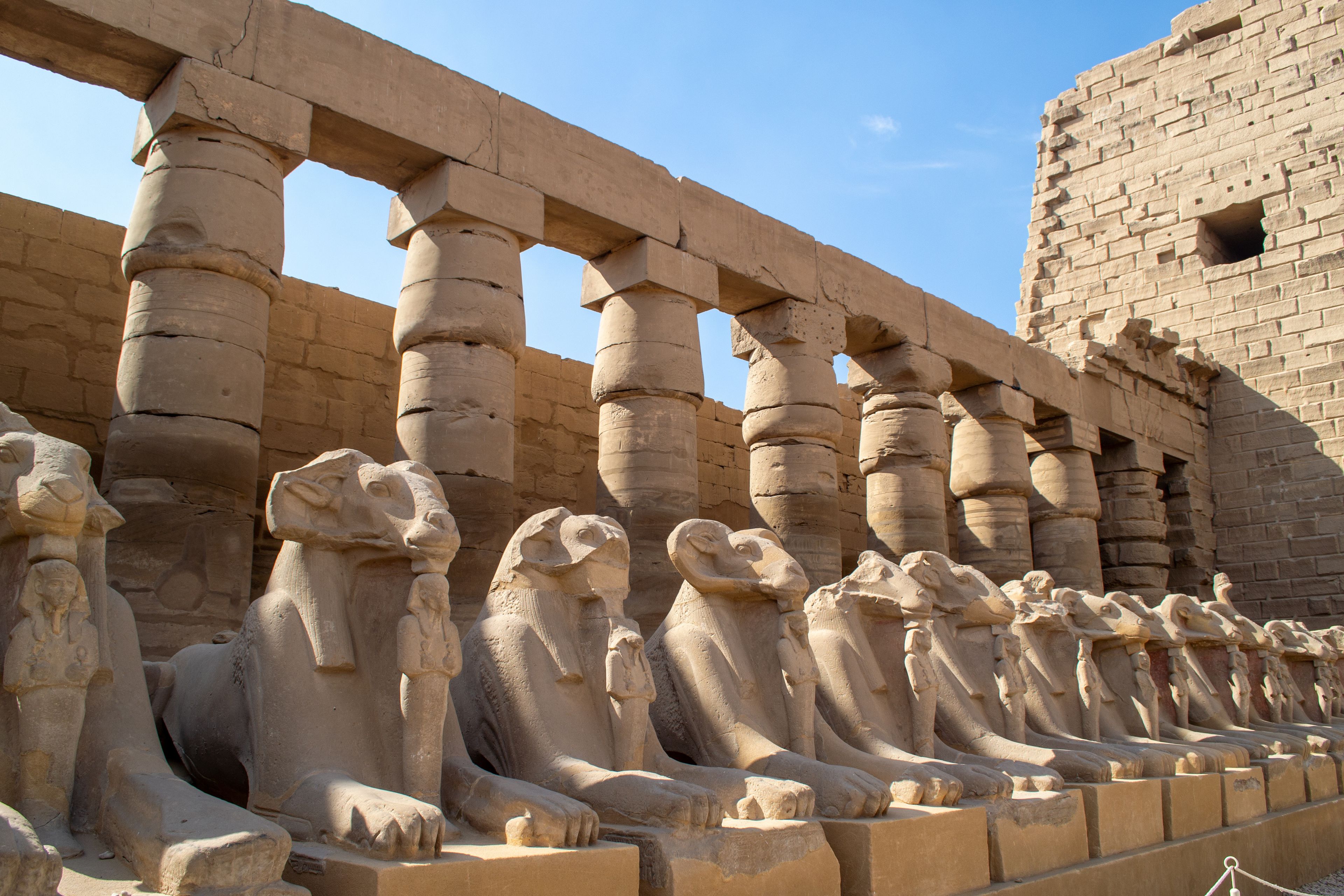
Above: photo of the row of ram-headed sphinx statues at the Karnak Temple Complex. These ram figures represent Amun, the chief deity of Thebes, and line the processional avenues leading into the temple precinct